

Circle of Humanity: Honoring the Civil Rights Movement, the Holocaust, and Our Shared Future
Charlotte’s vision for a Circle of Humanity urban plaza that will bring together a new Holocaust Memorial Sculpture with our city’s existing Martin Luther King, Jr. Memorial Statue, will create a one-of-a-kind space that exists nowhere else in the world. It reflects a vision rooted in deep relationships.
For decades, Minister Corine Mack, President of Charlotte-Mecklenburg NAACP, and I have been in conversation about the historic partnership between the African American and Jewish communities.
Together, Blacks and Jews helped found the NAACP in 1909. Together, philanthropist Julius Rosenwald and educator Booker T. Washington built more than 5,000 Rosenwald Schools across the South, expanding educational opportunities for Black students. Together, civil rights leaders marched, organized, and were jailed in the struggle to dismantle the segregation of the Jim Crow South. Together, they confronted antisemitism and racism – recognizing both as manifestations of the same poisonous ideology of white supremacy. Together, they took extraordinary risks, and in some cases gave their lives, in pursuit of justice.
History is filled with stories of this partnership. Jewish refugees from the Holocaust found refuge teaching at Historically Black Colleges and Universities throughout the South when other institutions closed their doors. Black soldiers serving in World War II helped liberate concentration camps, rescuing Jews who stood at the edge of death.
Two years ago, however, the conversation between Minister Mack and I took a new turn. Plans for the redevelopment of Marshall Park meant that Charlotte’s modest Holocaust Memorial and the Martin Luther King Jr. Memorial Statue would be impacted. Rather than addressing the status of the memorials separately, Minister Mack asked a transformative question:
What if they were brought together?
I had long heard calls from Charlotte’s Jewish community for a Holocaust memorial worthy to honor the dozens of Holocaust survivors who made Charlotte their home – so many who had since passed away. The existing Martin Luther King Jr. statue, meanwhile, sits in a location that is inaccessible to many visitors, surrounded by mulch. It overlooks the historic Brooklyn neighborhood – a thriving Black community destroyed in the name of “urban renewal.”
Minister Mack envisioned something larger. What if Charlotte created an educational plaza where the stories of the Holocaust, the Civil Rights Movement, and the enduring Black-Jewish partnership could be told together?
Marshall Park – the people’s park – is the perfect setting. For decades, it has been where Charlotteans have gathered to honor Dr. King, march for justice, protest injustice, and dream together. It could become a destination where students, residents, and visitors learn not only about history’s darkest chapters, but also about the power of communities standing together.
From that vision, Circle of Humanity: Monuments for Unity and Remembrance was born.
The vision is ambitious. Circle of Humanity will be a place to reflect, educate, and inspire. It will celebrate the victories of the Civil Rights Movement while honoring the victims and survivors of the Holocaust. It will tell the story of multicultural collaboration that has strengthened our community and invite future generations to continue building a more just society.
A remarkable partnership quickly emerged among the NAACP, the Stan Greenspon Holocaust Education Center, Queens University of Charlotte, the Charlotte Black/Jewish Alliance, and Charlotte-Mecklenburg County. Diverse community-based committees were established to guide urban design, memorial selection, education, fundraising, and community engagement.
On June 17, 2025, the Mecklenburg Board of County Commissioners unanimously authorized the County Manager to negotiate and execute a Memorandum of Understanding recognizing the future donation of a new Holocaust Memorial and the accompanying Circle of Humanity improvements at Marshall Park.
A national design competition followed.
Urban Design Partners, working with Groundworks Studio, was selected to create the educational plaza with a design called Woven Histories. Every aspect of the design – from the pathways to the contemplative space – symbolizes the unique and interconnected histories of Charlotte’s communities and invites reflection, learning, and dialogue.
Fifty-seven sculptors from across the country submitted proposals for the Holocaust Memorial. Eight semifinalists were selected based on artistic excellence, experience, feasibility, and connection to the project. Two finalist teams developed complete concepts, and twelve community engagement sessions held across the county brought together more than 850 Charlotte residents to share their perspectives.
The response was overwhelmingly positive.
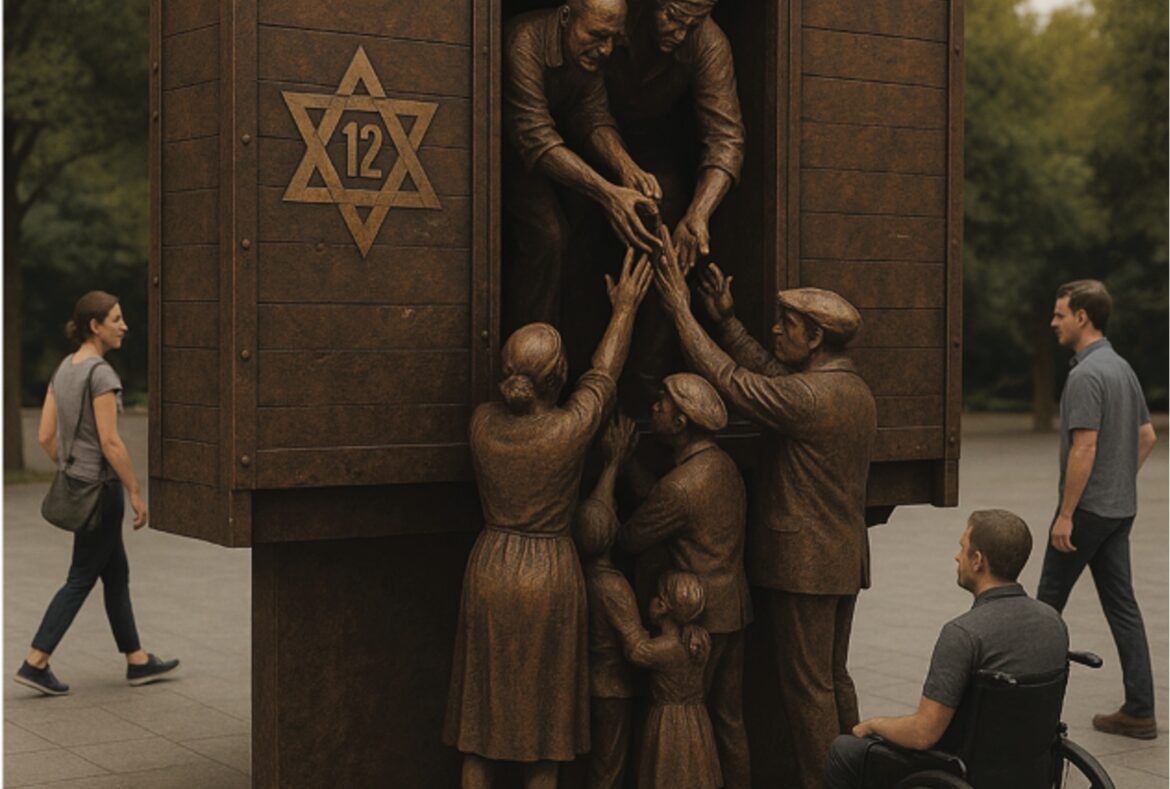
Participants consistently expressed a desire for a memorial that was emotionally powerful, historically accurate, and accompanied by meaningful educational programming. By a significant margin, the community selected In Transit: The Weight of Absence, designed by Durham, North Carolina, sculptors David Wilson and Stephen Hayes.
Their moving design depicts a railcar with seven members of a family being separated from one another, reflecting the countless individuals who were stripped of identity, autonomy, and human connection long before arriving at the concentration camps. It is a memorial not only to loss but also to the devastating human consequences of forced displacement and dehumanization.
Education has remained central to the project’s mission. Plans now include a digital learning hub and interactive educational experiences that explore Holocaust history, Civil Rights history, the shared Black-Jewish legacy, and the universal lessons of our common humanity.
On June 16, 2026, Minister Mack, David Wilson, Stephen Hayes, and I presented the project to the Mecklenburg Board of County Commissioners. The commissioners’ responses reflected the profound impact of the vision.
Commissioner Vilma Leake pledged, “Whatever I can do to help, I’m going to do it. I’m here to help.”
Commissioner Leigh Altman shared her family’s Holocaust story while reflecting on the moral foundation shared by both traditions: that every human being is created in the image of God. She described Circle of Humanity as a powerful reminder that confronting hatred requires recognizing our shared humanity.
Commissioner Arthur Griffin spoke of growing up in Charlotte witnessing and engaging with the longstanding partnership between African Americans and the Jewish community. He envisioned the impact Circle of Humanity could have on thousands of students attending the new Second Ward High School (set to open in 2028 after being closed for 59 years) just blocks away, helping future generations understand both the destruction of the Brooklyn neighborhood and the promise of reconciliation.
Board Chair Mark Jerrell praised the project’s vision, artistry, and symbolism, noting that at a time of increasing division, Circle of Humanity demonstrates what is possible when leaders from different communities choose partnership over separation.
The project budget is just under $1 million, including construction and an endowment for long-term maintenance and educational programming. The leadership team is committed to responsible stewardship, ensuring that donor investments create lasting impact while supporting North Carolina artists and Charlotte-based businesses.
Construction can begin once the necessary funds are pledged and raised. The hope is to dedicate the Circle of Humanity either on International Holocaust Remembrance Day and Martin Luther King Jr. Day in January 2028, or around Yom HaShoah and the anniversary of Dr. King’s assassination in April 2028. The timeline now rests in the hands of the community.
How can you help?
To learn more or become involved, contact me at [email protected] or Minister Corine Mack, [email protected].
Why does the Circle of Humanity matter?
Because antisemitism continues to threaten Jewish communities. Because racism continues to threaten Black communities. Because history reminds us that we are strongest when we stand together. And because Charlotte has an extraordinary story to tell — one that can inspire future generations to choose courage over hatred, partnership over division, and our shared humanity over fear.
No Comments